Wednesday, April 18, 2012
Baby Update
There were no baby rabbits. Either she was never pregnant (I couldn't feel any little ones in her belly) or she had dead ones and got rid of the evidence. Rabbits only do that if the babies are stillborn. A disappointment? Yes. However, it's also a relief. I can wait until the fall when I will have more time to deal with kits. Additionally, I'll at least know who the father is.

Friday, March 30, 2012
A Proud Mother

Luli in her cage
Meet the newest member of my little family, Shuppiluliuma the Younger, or Luli. Prone to licking feet, she has a docile personality, possibly due to her pregnancy. Since she was with kits when I bought her, I do not know when she will kindle (rabbit for give birth), nor do I know who the father is. When the kits are 10 weeks old, I will give them to a reputable pet store in Gokturk. If one for some reason has blue eyes, I might have to keep it.
 Luli from above
 As you can see, Luli has quite a lot of fur. I groom her almost daily and save the fur in a jar on the fridge. Someday, I might felt something out of it.
 Enkidu "prairie dogging"
 Meet the boy of the family, named after Gilgamesh's friend and travel companion. A spoiled bunny, he lives in a custom-built 2x1x1m cage. Capable of great vertical leaps, he has on occasion escaped from his cage. In the evenings, I release him and we hang out on the floor. As I read, he runs circles around me, grunting.

Enkidu has unusual hazel eyes.
You might wonder what happened to the other bunnies. Last year, the original Shuppiluliuma was put to sleep. She had a tumor that prevented her from eating. Ashurbanipal is still with us, yet she is the meanest rabbit I have ever met. When I put my hand in her cage to feed her, she comes after it with her jaws wide open. And she draws blood. She will soon be released in a park with other rabbits. I'm waiting for the weather to warm up a bit.
Thursday, August 18, 2011
The Definition of Wrong
Where I grew up in the middle of nowhere Wisconsin, lawn ornaments were common, from gnomes deer, both grazing and attentive, flamingos, the back sides of women in polka-dot dresses apparently working in a garden, to the random, rascist lawn jockey. Most were funny, kitsch, and seldom ironic, yet with the exception of the lawn jockey, somehow fit into the land or lawn scape.
Here in Cappadocia, however, lawn ornaments are just wrong. A few examples suffice as evidence.
 Milk maids over Pigeon Valley
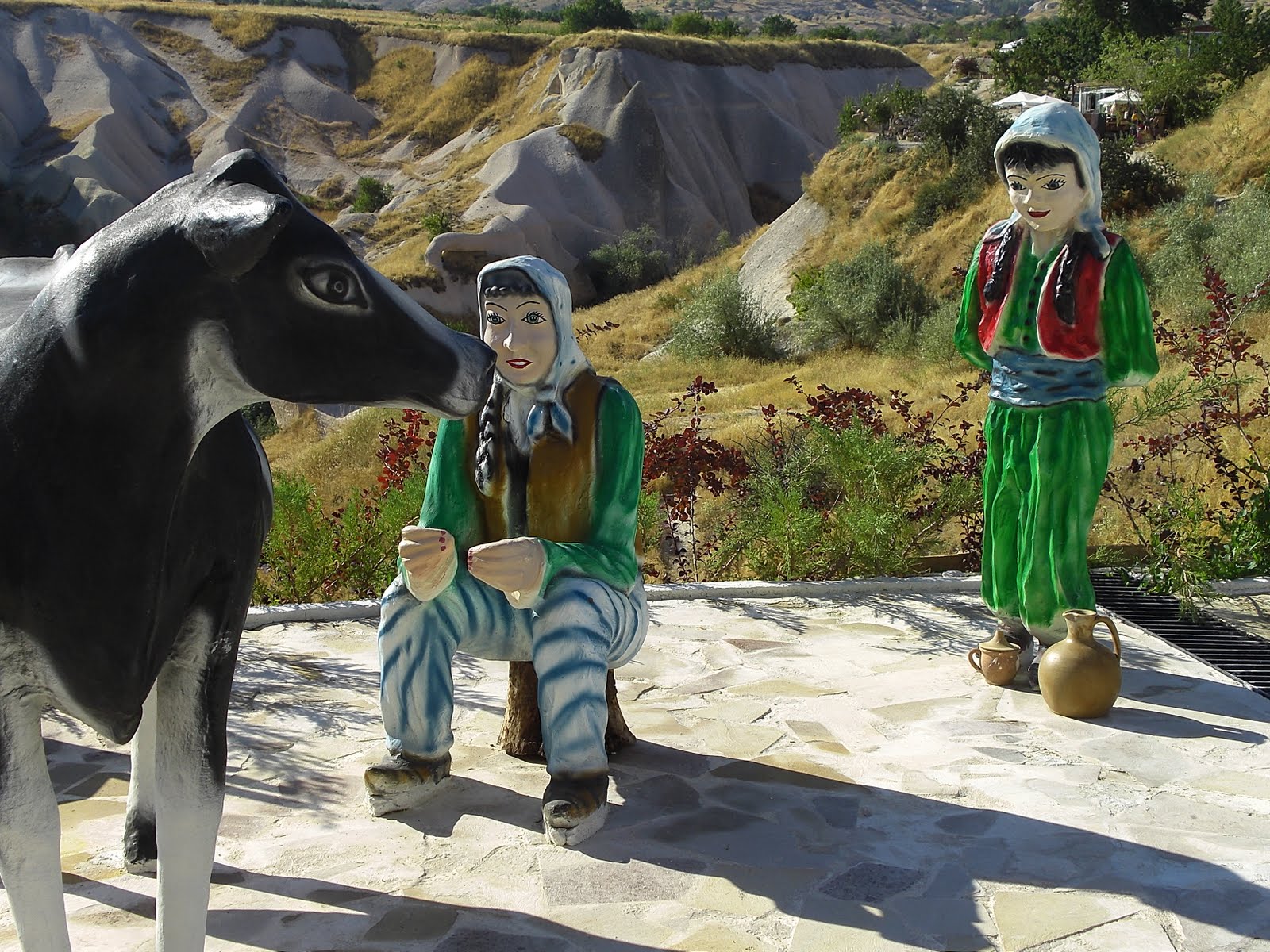 Perhaps she should get a bit closer to the animal.
Friday, August 12, 2011
Driving Miss Rebecca
In a previous post, I alluded to the way in which Georgians drive. It deserves a post on its own.
There are apparently three rules of the road, the first two of which are fast and first. When the roads are relatively clear of other vehicules, our drivers reached nearly terrifying speeds. What's worse, however, is their need to pass others, on curves, in front of oncoming trucks and farm machinery, up hills, on mountain roads... We foreigners, packed in the back seat with ministery representatives and assistants, cringed and cowered at near collisions, but to our Gerogian colleagues, it was business as usual. It is the law that front seat passengers and drivers wear seatbelts. Apparently, it's safe in the back seat. Nevertheless, some drivers are insulted when you reach for the required belt, and insist you don't wear one. I assure them that I trust their driving (a blatant lie), it's just the other crazy drivers I'm worried about.
Without question, the most hair-raising of all is the ministery driver who calmly took our lives in his hands. Thankfully, I only once had the pleasure of being his passenger in the 5 hour drive from Zugdidi to Tibilisi. Just before reaching the capital city, we encountered heavy traffic including car carriers and other massive trucks. At one point, while passing a long semi, he realized that the oncoming tractor-combine was approaching too closely and rapidly for him to maneouver around and in front of the aforementioned vehicule, so he quickly swerved left onto the nearly non-existant left shoulder, barely missing a concrete barrior before speedily returning to his proper lane. It is customary for Georgians to cross themselves when approaching the many churches on either side of the road. I believe I crossed myself before the driver recovered his proper place in the right-hand lane.
The last, but certainly not least rule of the road is that farm animals have the right of way. Cows roam freely in the villages and on the edges of the city, herds of which are sometimes slowly driven down and across roads. Some tend to stand in the middle of the road, contemplating whatever it is that cattle contemplate, with little or no inclination to move forward, backward or sideways. It is the driver's responsibility to accomodate them. I swore on several occasions that the outside of the windshield would be covered in bloodied hamburger and my cracked skull from the inside. I'm more than happy to say there were no collisions between car and cow.
There are apparently three rules of the road, the first two of which are fast and first. When the roads are relatively clear of other vehicules, our drivers reached nearly terrifying speeds. What's worse, however, is their need to pass others, on curves, in front of oncoming trucks and farm machinery, up hills, on mountain roads... We foreigners, packed in the back seat with ministery representatives and assistants, cringed and cowered at near collisions, but to our Gerogian colleagues, it was business as usual. It is the law that front seat passengers and drivers wear seatbelts. Apparently, it's safe in the back seat. Nevertheless, some drivers are insulted when you reach for the required belt, and insist you don't wear one. I assure them that I trust their driving (a blatant lie), it's just the other crazy drivers I'm worried about.
Without question, the most hair-raising of all is the ministery driver who calmly took our lives in his hands. Thankfully, I only once had the pleasure of being his passenger in the 5 hour drive from Zugdidi to Tibilisi. Just before reaching the capital city, we encountered heavy traffic including car carriers and other massive trucks. At one point, while passing a long semi, he realized that the oncoming tractor-combine was approaching too closely and rapidly for him to maneouver around and in front of the aforementioned vehicule, so he quickly swerved left onto the nearly non-existant left shoulder, barely missing a concrete barrior before speedily returning to his proper lane. It is customary for Georgians to cross themselves when approaching the many churches on either side of the road. I believe I crossed myself before the driver recovered his proper place in the right-hand lane.
The last, but certainly not least rule of the road is that farm animals have the right of way. Cows roam freely in the villages and on the edges of the city, herds of which are sometimes slowly driven down and across roads. Some tend to stand in the middle of the road, contemplating whatever it is that cattle contemplate, with little or no inclination to move forward, backward or sideways. It is the driver's responsibility to accomodate them. I swore on several occasions that the outside of the windshield would be covered in bloodied hamburger and my cracked skull from the inside. I'm more than happy to say there were no collisions between car and cow.
Thursday, August 11, 2011
Rustavi Photos
These photographs correspond to the post below. Entrance to the public school in Rustavi
 Entrance to the public school in Rustavi
The rear of the building is in worse shape but requires an effort to photograph.
 From a window inside the school
 Another window view
This gives a better view of the condition of the building.
 My classroom
 From a window inside the school
 Another window view
This gives a better view of the condition of the building.
 My classroom
Due to the flash, this room seems less dingy and more cheerful than it actually is.
 The dangerous floor and my foot
 The teacher's desk
 The private restroom for students
 The dangerous floor and my foot
 The teacher's desk
 The private restroom for students
Again, due to the flash, this appears brighter and cleaner than it is.
 The private restroom sink
 A poster project by a great group of teachers
 The private restroom sink
  A poster project by a great group of teachers
The reference to slavery is very tongue in cheek, at least I hope.
Wednesday, August 10, 2011
An Unexpected Addition to My CV
A friend called me about a month before school finished to ask if I wanted to make a pile of money. Well, yes, why wouldn't I? E-mails sent, a contract signed, and I found myself one of a group setting off to Georgia (the nation, not the state) to train teachers. Again, I accepted a job for which I wasn't exactly qualified, but they needed bodies yesterday, and for that, I do qualify. Oddly, and to my surprise, one of my first thoughts on hearing about a job connected to a major publishing company was "This could be good for my career." Where that thought came from is a small mystery to me because I never think in those terms.
The Project
Recently, the Ministery of Education of Georgia decided that, beginning from first grade, all students in public schools will have English lessons. Additionally, they chose a series of books ranging from levels 1-6. This is an ambitious project, revolutionary for the educational system of the country. Our job was to introduce the new books and to train teachers how to use the first level. The Ministery's goal, as I understand it, was to train all its English teachers, roughly 10,000 over the course of July. In total, 11 of us trained approximately 5,000 which is not too shabby for a month's work. We traveled to villages where teachers came to us at schools varying in (dis)repair. The teachers themselves were a mixed group of those who spoke English very well, to those who could utter only a few catch phrases or sing She'll be Comin' Around the Mountain. (To my regret, I missed that performance by a woman in her 70s.) At first, several of the trainers were met with resistance. Previously, teachers were allowed to choose which books would be used in the classrooms and therefore many felt forced upon to make sudden changes. Since I came a few weeks later than the rest, and since word had spread in particular after a spot on the news, I encountered little resistance and no aggression.
Rustavi
After a death-defying car ride from Tibilisi with colleagues, and an assistant from English Book, the store with which the publishing company is connected, one of the other trainers pointed to an abandoned-looking, shell-shocked Soviet era building in the village of Rustavi and declared that was the school. In my very own subtle and polite way, I said, "Shut up." Yet, that was where my day was to begin.
My classroom was furnished with desks and chairs of dubious stability, a teacher's desk, the door of which fell into my hands as I opened it to reveal rusted metal stands for science experiments, a green board dating from god knows when, and a dirty parquet floor whose wooden slabs often lifted off the ground when walked on. Everything was covered in a layer of dust. I set up a laptop and tried to connect it to a projector to show training videos from the publishing company against the wall. For the life of me and our assistants, I couldn't get either to work and therefore became CD, DVD and unqualified teacher-trainer all wrapped into one package. And it was a sweaty package indeed. Working in temperatures in the low, humid 40s with no air currents, I consumed litres of bottled water and fanned myself constantly. Since I'm a very active teacher, (I jump around, gesture a bit wildly, dance and sing...) I became very unfeminine, dripping sweat everywhere.
Now for what might possibly be a bit too much information. Despite copious sweating, a person does need to relieve herself after drinking litres of water. Here, however, we showed heroic restraint and ventured to the toilets only when absolutely necessary, sometimes waiting until after a hair-raising, half hour journey to the hotel. Students at this school can choose to go in what first appears to be a closet but which reveals itself to be a "Turkish toilet" equipt with a small sink and cold water. Both are filthy and badly lit. Their second option is a room with about six tiled, doorless stalls, (who needs privacy?) also containing Turkish toilets. My colleagues discovered the key to the teachers' restroom which seemed luxurious in comparison. Through a kind of storage room for broken furniture and faded Christmas decorations, there is a small, similarly dirty room with a seat toilet. This was liberally wrapped with Soviet style (think thin Kraft paper) toilet paper before use. Needless to say, travel experience has taught me to stock my bag with moist towelettes. I don't leave home without them.
As you have probably concluded, the rest of the school was not a joyful place, and I often thought about what it would be like to study or work there. The stair railings are dangerously loose. Many of the windows were cracked or broken, and the radiators date from an earlier epoch. From the windows, the building exterior seems to be peeling off in chunks. Some of the floors were recovered in cheap linoleum, an improvement over the loose parquet. One small room on the ground floor is dedicated to prayer, complete with icons, prayer books and models of churches. For some reason, I found this a charming space.
While I have painted a dingy picture of the school, my week working in Rustavi was not unpleasant. Our assistants, Tako and Mari, were fantastic. They helped me connect seemingly unconnectable projectors and cables, they brought us fresh hachapuri for lunch and made sure we had bottles of melted ice to drink throughout the day. With an ever-present representative from the ministery, they trouble-shot problems and answered questions that were not understood in English or outside of our domain. And both women are incredibly nice. A number of the teachers were quite motivated, creative, and responsive despite the changes forced upon them, the heat, and the distances they had to travel to the school. I've become invested in the project and hope to return over one of my school breaks to observe teachers, maybe teach some first graders (that will be an unprecedented event!) and actually have some time to see and appreciate the country itself. After work, we had very little energy or motivation to do much more than sit around the hotel. Days off were generally taken up by bus or ministery van rides (for a godless woman, I certainly relearned to pray) to another village, so we didn't have much opportunity to actually see where we were.
After Rustavi, I went to Kutaisi and Zugdidi for three days each. More posts on these places and a bit of Tibilisi tourism to follow.
Tuesday, June 7, 2011
Good Fortune
Before I stopped at the convenience store near my apartment the other day, a young pigeon fell from either the sky or off a balcony above me, just left of my center. It landed a few centimeters from my foot. Apparently, it's good luck if bird poop hits you, but what if the whole animal does?
Subscribe to:
Posts (Atom)